
Public-Private Partnerships and Cross-Sector Collaboration to Drive Robotics Opportunities

  • 2025-11-07

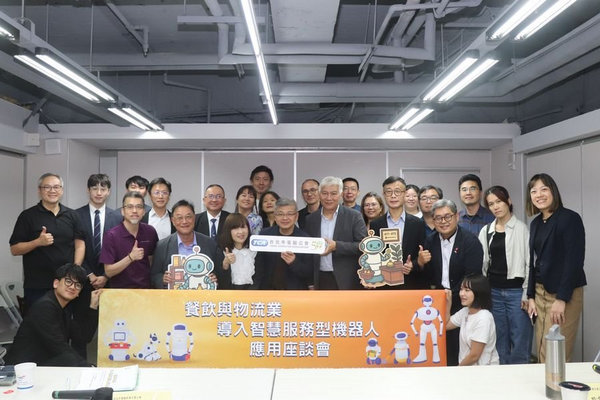
To better understand the key developments on both the supply and demand sides of the intelligent robotics industry and to assist the government in optimizing promotion and support mechanisms, the Taipei Computer Association (TCA), together with the Chinese Society of Logistics, the Taiwan Chain Stores and Franchise Association, and the Taiwan Internet of Things Technology and Industry Association, jointly held the “Symposium on the Application of Smart Service Robots in the Food and Logistics Industries” on November 6.

Participants agreed that the food and logistics sectors are largely composed of small and medium-sized enterprises (SMEs). Therefore, the successful adoption of smart service robots in these industries will require government guidance and financial support. Through cross-sector co-creation alliances, the industry also looks forward to fostering public-private collaboration to promote the practical implementation of smart service robots and unlock new business opportunities.

At present, businesses across various sectors—including transportation, hospitality, food services, healthcare, and inspection—are pioneering a demand-driven approach that connects robotics hardware and software solutions tailored for each domain. These efforts have led to the formation of the Robotics Innovation Alliance (RIA), which aims to advance the concept of “Demand-Driven Development × Solution Matching × Global Integration.” The alliance seeks to accelerate the practical deployment of robotics technologies and the development of a sustainable industrial ecosystem.

According to Mr. Huang Yi-Feng, Deputy Secretary-General of the Taipei Computer Association, the alliance will identify and evaluate the demand for smart robot adoption across different application domains while analyzing the technical bottlenecks faced by solution providers. Beyond facilitating effective supply-demand matchmaking and promoting commercialization, the alliance also intends to consolidate industry feedback to offer policy recommendations that help the government refine its support and promotion strategies.

Participants in the symposium included representatives from industry leaders such as Tofu Restaurant Group (Juen Dou Fu), Ching Ching Wedding Banquet Group, Dong Yu Hui, Chuan Zong Foods, Ri Ri Che, Full Shun Logistics, Heng Hsiang Logistics, and Huali Co., Ltd. They shared their valuable experiences in adopting robotics solutions, emphasizing that beyond addressing labor shortages, human-robot collaboration can significantly reduce employees’ workloads and improve operational efficiency. However, they also pointed out that many enterprises are relatively small in scale and would greatly benefit from more active government support in the future.

On the supply side, key robotics solution providers—including Techman Robot, Foxnum Precision Industry, Heyi Technology, Kardel, and U-Micro Technology—showcased their latest developments and presented successful case studies, demonstrating the strong capabilities of Taiwan’s service robotics industry.

Mr. Ke Tsung-Yuan, an analyst at the Industry Intelligence Research Institute (MIC) of the Institute for Information Industry (III), shared that logistics currently represents the largest application field for service robots. The food and beverage sector, meanwhile, serves as the beachhead for smart service robots entering unstructured environments. He added that the emerging Robotics-as-a-Service (RaaS) business model—including subscription-based models—will play an increasingly important role in meeting SMEs’ needs for cost-effective smart service robot adoption.